
Local Second Brain
A searchable record of projects and decisions that always leads back to the original evidence.
- The work
- Research infrastructure
- My role
- Architecture, Python implementation and retrieval validation
- Year
- 2026
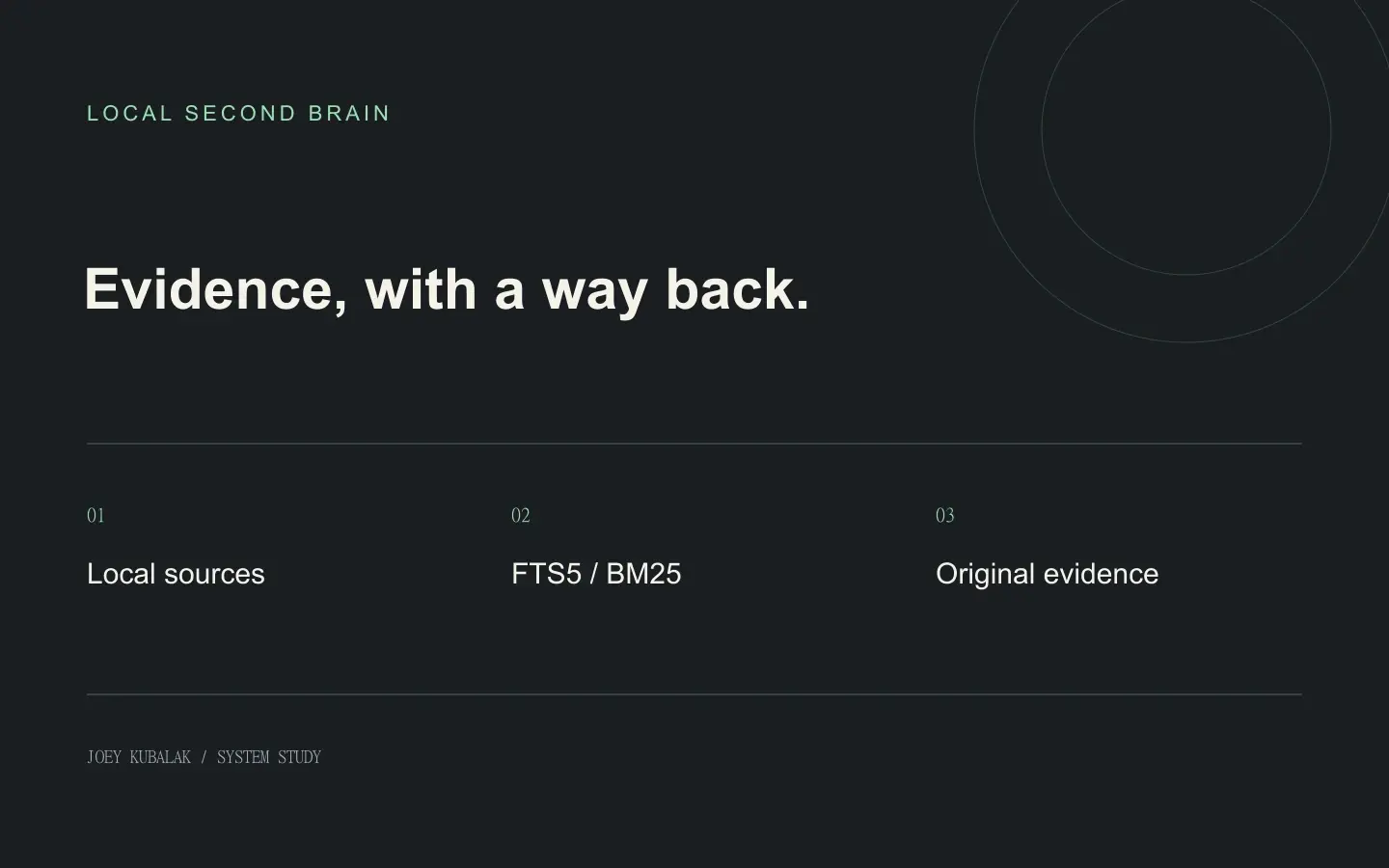
Useful work was scattered across project documents and long development conversations. I built a local second brain that can find the relevant passage and lead back to the evidence behind it.
The challenge.
Retrieving a familiar phrase is easy to confuse with recovering a decision. The system needed to distinguish original evidence from summaries, keep projects separate and make missing or stale sources visible before an answer relied on them.
Decisions that
shaped the work.
Keep evidence close to search
SQLite holds the retained source text alongside a compact FTS5 search index. BM25 ranking and a modest recency adjustment provide local keyword retrieval. Project provenance, source locations and fingerprints stay attached to the results, so finding a passage is the beginning of verification.
Respect the shape of technical questions
Quoted phrases, paths and identifiers remain required anchors. A failed exact match is not silently broadened into something similar. Project scoping follows the original document path or working directory, while default filtering suppresses path listings, copied build output and duplicate passages.
Make maintenance inspectable
Incremental ingestion uses a process lock, records source health and preserves coverage gaps. Transactional index updates keep search aligned with the source records. Search and inspection open the database read-only; ordinary refresh stays local. Generated summaries remain attributed pointers with explicit links to their evidence.
From recollection to evidence
A result is useful when another person can follow how it was established.
Collect
Retain supported local documents and conversation records with their provenance.
Find
Search distinctive terms within the relevant project and inspect the matching passage.
Verify
Open the original source, check its date and separate a proposal from a completed result.
Research infrastructure used in the work
The implementation includes ingestion, scoped search, source inspection, health reports and a repeatable verification workflow. It helped recover the project histories behind this portfolio, with current original files checked before those histories became public descriptions.
Keep exploring.